Buying an Exoskeleton for Your Parents? Here Are the Five Things That Actually Matter
Your mother has been cutting her morning walks shorter. The hips are fine, the cardiologist is satisfied, but something in the gait has changed — she's slower, more hesitant on steps, quicker to sit down. It's not a medical emergency. It's the particular, frustrating physics of aging muscle.
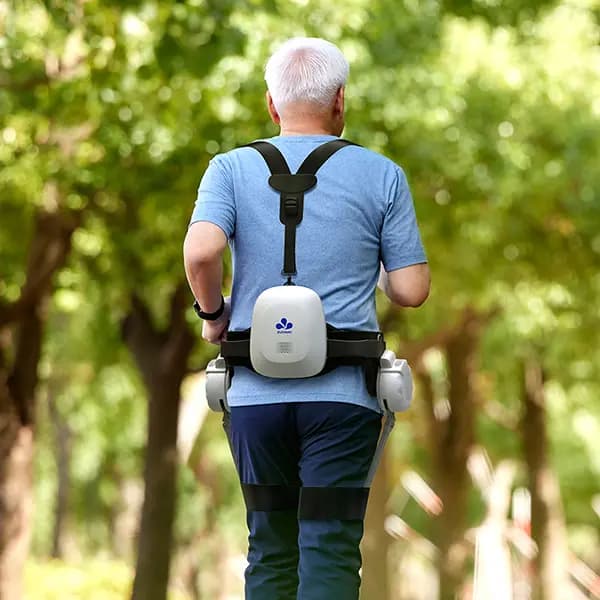
Your mother has been cutting her morning walks shorter. The hips are fine, the cardiologist is satisfied, but something in the gait has changed — she's slower, more hesitant on steps, quicker to sit down. It's not a medical emergency. It's the particular, frustrating physics of aging muscle.
You've heard about exoskeletons. You've also seen prices that made you close the browser. Here's the thing: the technology has genuinely moved. The elder mobility exoskeleton market hit $800 million in 2025 and is growing at nearly 29% annually — driven partly by the fact that devices are getting lighter, smarter, and more affordable. There are real products worth buying. But there are also mismatches that will leave a device gathering dust in a cupboard within two weeks.
This guide is for adult children — typically the ones doing the research and cutting the check — shopping for a parent aged 65–80 who has mobility decline but is not managing post-stroke paralysis, spinal cord injury, or severe neuromuscular disease. That distinction matters enormously.
Quick Takeaways
- The right exoskeleton depends on intended use case first — get this wrong and nothing else matters.
- Consumer-grade exoskeletons (like the Hypershell X Pro) are not medical devices and provide no balance assistance; they're for walking endurance and load reduction.
- Medical-grade rehabilitation devices (Hyundai X-ble MEX, Fourier ExoMotus) require clinician involvement and are not direct-to-consumer purchases.
- For most active seniors with mild gait fatigue, a 1.5–2 kg powered hip-assist device is the sweet spot.
- Battery range is almost always overstated; assume 40–50% of rated range under real-world, hilly urban conditions.
- Local service and warranty coverage is critical in Hong Kong and APAC — a $1,200 device with no local repair support is an expensive paperweight after the first hardware issue.
The Hard Question First: What Kind of Help Does Your Parent Actually Need?
Before comparing spec sheets, answer this honestly: what is the mobility problem you're trying to solve?
Endurance fatigue — "Mum can walk, but she gets tired after two blocks and needs to stop" — is a walking augmentation problem. A consumer exoskeleton that assists hip extension, like the Hypershell X Pro, could genuinely help. It reduces perceived leg load by up to 66 lbs (30 kg) and improves leg strength output by 40% in a 2 kg wearable.
Balance instability — "Dad wobbles on uneven ground and I'm terrified of a fall" — is fundamentally different. This requires a device with stability support, and probably clinician involvement. Consumer exoskeletons explicitly offer no balance assistance; the Hypershell site is clear that the device assists from knee-up and does not address balance or severe neuromuscular conditions.
Post-surgical recovery / gait retraining — "Dad had a hip replacement six months ago and his gait is off" — is a medical rehabilitation use case requiring a clinical-grade device and physiotherapy supervision.
Stair climbing difficulty — some devices handle stairs, some don't, and the difference matters enormously in Hong Kong's hilly, multi-level urban landscape.
Mapping your parent's actual problem to the correct device category will save you thousands of dollars and enormous frustration.
<!-- IMG: alt="Side-by-side product comparison of Hypershell X Pro consumer exoskeleton and Hyundai X-ble MEX medical exoskeleton" prompt="Clean product photography comparison showing a lightweight consumer hip exoskeleton (left) alongside a full lower-limb medical rehabilitation exoskeleton (right), studio white background, professional product lighting." -->
1. Intended Use Case: The Foundation of Every Decision
The market broadly divides into three consumer-accessible tiers for your use case:
Tier 1 — Consumer Walking Augmentation (Under $1,500) Best for: mobile seniors with endurance fatigue, mild joint pain, or fitness goals who have no balance impairment.
The Hypershell X Pro ($1,199) is the current benchmark. It weighs 2 kg, straps at the hip and thighs, and uses an AI MotionEngine to detect and assist 10 motion types automatically: walking uphill, downhill, on gravel, up/down stairs, running, cycling, and more. IP54-rated for light rain. Maximum speed assistance up to 12.4 mph. Battery-rated at 10.8 miles; expect 5–8 miles in real-world hilly use.
Important limitation: the Hypershell assists hip and upper leg only. It explicitly does not provide balance assistance. If your parent's primary issue is fall risk or balance, look elsewhere.
Tier 2 — Prosumer/Clinical-Adjacent Knee Assistance ($7,000–$15,000) Best for: seniors with knee osteoarthritis, post-surgical rehabilitation, or moderate lower-limb weakness who don't need clinical-level gait restoration.
The Roam Robotics Ascend uses pneumatic actuators inside a carbon fiber knee brace — custom-fitted, FDA Class I registered, and partially covered by Medicare in the US. A clinical study found 46% average pain reduction and 67% functional improvement in knee osteoarthritis patients. The backpack-worn SmartPak provides 1–3 hours of continuous use. Weight under 900 grams per leg. Not available direct-to-consumer in HK — requires a provider engagement.
Tier 3 — Medical Rehabilitation Devices (Clinician-Prescribed) Best for: parents with post-stroke hemiplegia, spinal cord conditions, or severe gait impairment. These require a physician prescription and clinical supervision.
The Hyundai X-ble MEX (Medical EXoskeleton) received Class III medical device approval in South Korea in November 2025. It supports walking, standing, sitting, turning, and stair climbing (up to 25 cm step height). Weight: 18 kg; battery life: 90 minutes at 0.75 km/h. Maximum speed: 1.2 km/h. Height range: 160–190 cm; maximum body weight: 100 kg. This is a clinical tool, not a solo consumer purchase.
The Fourier ExoMotus M4 is a Singapore-born rehabilitation exoskeleton with a strong APAC distributor network, designed for early-stage gait retraining after neurological events. Fourier's pricing was historically one-third of Western competitors.
2. Fit and Weight: The Underrated Dealbreakers
Exoskeletons do not fit everyone. This is not a nuance — it is a product return waiting to happen.
Height range: Most devices specify a usable height window. The Hyundai X-ble MEX works for 160–190 cm. The Hypershell X Pro is adjustable for hip/thigh circumferences but works best for adults within a moderate build range. Check the spec sheet for your parent's height and weight before purchasing.
Donning time: How long does it take to put on without help? Many elder care professionals consider anything over 5 minutes a friction point that leads to non-use. The Hypershell X Pro can be put on in about a minute. Medical rehabilitation devices often require a trained caregiver to fit correctly.
Device weight: The received wisdom in elder mobility is that a device weighing more than 2 kg starts to become a burden for frail adults when unpowered (e.g., during battery charging or device failure). The Hypershell X Pro weighs exactly 2 kg. The Hyundai X-ble MEX weighs 18 kg — appropriate for a clinical setting with staff assistance, not for unsupervised home use.
Materials and comfort: Hip and thigh contact points should be well-padded and non-abrasive for extended wear. Buckle systems should be manageable with arthritic hands. The Hypershell uses polymer buckles and padded straps; clinical-grade devices use more complex harness systems.
3. Battery Life and Real-World Range: Divide by Two
Every exoskeleton on the market overstates range in marketing materials, because range is measured on flat ground at optimal speed with factory-calibrated settings. Your parent will use it on Hong Kong's hillside paths, in wet weather, carrying a bag.
A useful rule of thumb: assume 40–50% of rated range for real-world urban/hilly conditions at moderate power assistance.
| Device | Rated Range | Realistic Hilly Range |
|---|---|---|
| Hypershell X Pro (single battery) | 10.8 miles | ~5 miles |
| Hypershell X Pro (both batteries) | 21 miles | ~9–10 miles |
| Hyundai X-ble MEX | 90 min continuous | 45–60 min typical |
| Roam Ascend | 1–3 hours | 1–2 hours moderate activity |
The Hypershell X Pro includes two batteries as standard — this is a significant practical advantage. Battery swap in the field is possible. Charging from flat takes approximately 2 hours.
For medical-grade devices, battery life is often more limited (the Hyundai X-ble MEX runs 90 minutes at clinical pace) — but the context is supervised rehabilitation sessions, not all-day use.
Look for: battery swap capability, charge time under 3 hours, and cold-weather battery ratings if your parent is in a cooler climate or travels. The Hypershell Pro X battery is rated to −20°C, an unusual selling point that matters for winter travel.
4. Safety, Emergency Stop, and Fall Detection
This is non-negotiable for elder users. Ask every manufacturer these questions before purchasing:
Does it have an emergency stop? The Hypershell has a power-off button that immediately cuts motor assistance. Medical-grade devices typically have therapist remote controls and automatic shutdown on abnormal load detection.
What happens on battery death? The device should become "transparent" — i.e., not resist normal walking if the motor loses power. A device that locks joints or becomes a dead weight is a serious fall risk. The Hypershell is designed to allow free movement when powered off.
Does it detect falls? Consumer devices generally don't actively prevent falls (no active balance compensation). Medical rehabilitation devices (Wandercraft Atalante X, Hyundai MEX) have stability systems, but these require clinical use. Some newer Chinese elder-care devices include basic fall-detection sensors that alert caregivers.
Is the maximum speed appropriate? A device with a maximum assisted speed of 12.4 mph is appropriate for an active senior but could be alarming for a frail one. Check whether speed can be capped via the app.
IP rating: IP54 (the Hypershell's rating) handles dust and light rain. Sufficient for daily outdoor use in most weather. Look for at least IP54 for a device that will be used in subtropical climates.
5. Service, Warranty, and Local Support in HK and APAC
This factor kills more exoskeleton purchases than any other in this region. A $1,200 device with a US-only warranty and no local repair partner is a disposable gadget. A $10,000 clinical device with no local distributor is a procurement nightmare.
What to check:
- Warranty length: The Hypershell warranty is 1 year, with a rated service life of 3,000 km (~1,900 miles) under normal use. After-sale support is primarily handled via the brand's global support channels.
- Local distributor: Does the brand have a service partner in Hong Kong or mainland China? Hypershell has a growing Asia presence and Chinese-language support. Fourier Intelligence is Singapore-headquartered with active APAC distribution. German Bionic and Roam Robotics have limited direct APAC footprints as of mid-2026; factor in international shipping costs and lead times for repairs.
- Software updates: Devices with OTA (over-the-air) updates — German Bionic Apogee, Hypershell — improve over time. Devices without OTA are locked to launch-day software.
- Replacement parts: Battery packs, straps, and buckles wear out. Confirm that consumable parts are available without returning the whole unit.
The Hong Kong Productivity Council has begun running workshops on wearable robotics and exoskeletons in elder care contexts, a sign that the institutional infrastructure for APAC support is developing — though it remains early.
What Not to Buy
Some honest disqualifications:
Don't buy a consumer exoskeleton for a parent with balance problems. Devices like the Hypershell explicitly provide no balance stabilization. If your parent has a history of falls or significant gait instability, consult a physiotherapist before any purchase. A fall while wearing an unpowered 2 kg frame strapped to the hips could make things worse.
Don't buy a clinical rehabilitation exoskeleton (MEX, ReWalk, Atalante) without clinical involvement. These devices are designed for supervised therapy sessions with trained staff. Using them at home without a proper assessment and training program is unsafe.
Don't trust battery range on marketing materials. Divide by two, as discussed above.
Don't buy a no-name exoskeleton from an e-commerce platform without verifiable support. The Chinese consumer market now has devices priced at 2,000–8,500 yuan, but warranty claims, parts availability, and device calibration support are inconsistent. The price differential versus a name-brand device rarely justifies the support risk for an elderly user.
Head-to-Head: Hypershell X Pro vs. Hyundai X-ble MEX
| Hypershell X Pro | Hyundai X-ble MEX | |
|---|---|---|
| Category | Consumer / prosumer walking augmentation | Medical rehabilitation |
| Weight | 2 kg | 18 kg |
| Motor output | 800W | Therapeutic (not rated in watts) |
| Speed assist | Up to 12.4 mph | 1.2 km/h max |
| Battery | ~5–10 miles real-world | 90 min |
| Balance assist | None | Clinical stability support |
| Use case | Active seniors with endurance fatigue | Clinical gait rehabilitation |
| Prescription needed | No | Yes |
| Price | $1,199 | Not published (clinical) |
| Regulatory status | Consumer device, IP54 | Class III medical device (Korea) |
The right choice depends entirely on your parent's needs. For an active 70-year-old who gets tired walking hilly streets, the Hypershell X Pro is compelling and accessible. For a parent post-stroke with genuine gait impairment, the MEX or equivalent is the appropriate tool — but involves a clinician, not a credit card.
FAQ
Can my 75-year-old parent use an exoskeleton independently at home? Consumer devices like the Hypershell X Pro are designed for independent use after an initial learning period of a few sessions. Medical rehabilitation exoskeletons are not; they require trained clinical supervision. Match the device category to the actual need.
Will an exoskeleton prevent falls? Consumer exoskeletons do not actively prevent falls — they provide no balance stabilization. Some clinical-grade devices (Wandercraft Atalante X) are self-balancing, but these are hospital tools. If fall prevention is your primary concern, consult a geriatric physiotherapist before selecting any device.
Is an exoskeleton covered by Hong Kong health insurance? As of mid-2026, consumer-grade exoskeletons are not covered by standard Hong Kong health insurance plans. Clinical rehabilitation exoskeletons used in accredited hospital programs may be partially covered through rehabilitation benefit riders. Check your parent's specific policy.
How long does it take to get used to wearing one? Most users of consumer hip-assist exoskeletons report becoming comfortable within 3–5 uses. Clinical devices require formal training programs. The Hypershell's AI adapts to the user's gait automatically, which shortens the learning curve compared to manually-tuned devices.
Want to compare current devices side by side or request a product demonstration? Visit exoskeleton.boutique/catalog for curated consumer and prosumer options, or submit an inquiry for elder care consultations and volume pricing.
related: Introduction to Exoskeletons | related: The Exoskeleton Breakthrough Nobody's Talking About